Rental Property Record-Keeping for Taxes: What Landlords Must Track (2026)
What records landlords need to keep for taxes — repairs vs. improvements, receipts, service history, and how to document maintenance so you never lose a deduction. A practical guide for small landlords.
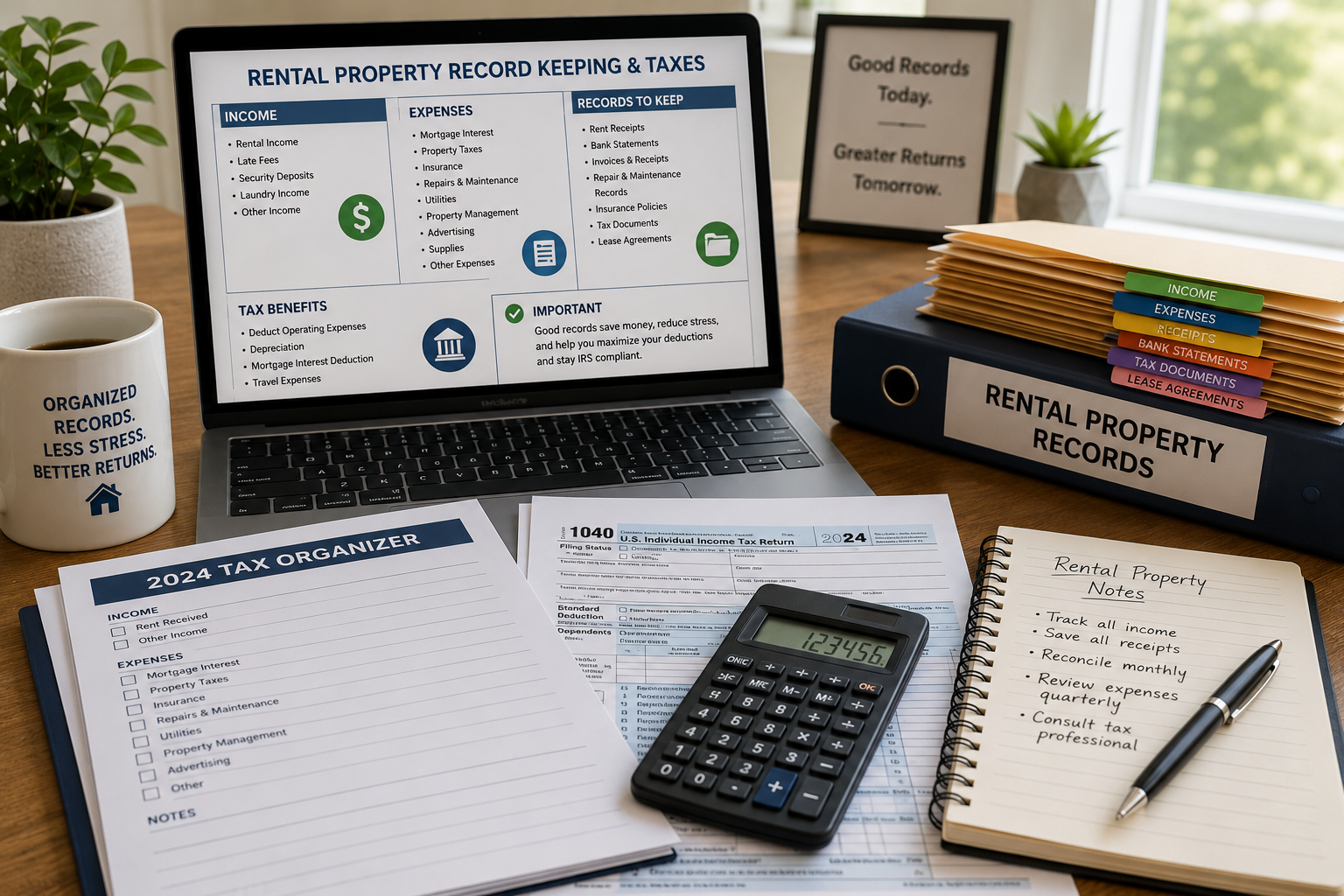
Rental Property Record-Keeping for Taxes: What Landlords Must Track (2026)
Short answer: the deduction you can't document is the deduction you lose. For rental owners, maintenance and repairs are deductible — but "I paid a guy in cash last spring" is not a record. Good record-keeping turns real money you already spent into real money back at tax time, and it protects you if you're ever audited.
(This is general information, not tax advice — confirm specifics with your accountant.)
The one distinction that matters most: repairs vs. improvements
The IRS treats these very differently, and getting it wrong costs you:
- Repairs keep the property in working order — fixing a leak, patching drywall, servicing the furnace. Generally deductible in the year you pay.
- Improvements add value or extend useful life — a new roof, a new HVAC system, a kitchen remodel. Generally capitalized and depreciated over years.
The catch: to defend how you classified something, you need the record — what was done, when, by whom, and for how much. That's why a dated service history isn't just organization; it's tax documentation.
What every landlord should keep
| Record | Why it matters |
|---|---|
| Receipts & invoices | Proof of every deductible expense |
| Service history (dated) | Shows repairs vs. improvements and supports the deduction |
| Asset details (make/model/serial, install date, cost) | Sets the depreciation basis and warranty proof |
| Vendor info | Who did the work, for 1099s and follow-up |
| Before/after photos | Supports condition and the nature of the work |
| Mileage & supplies | Small deductions that add up across properties |
The mistakes that cost landlords deductions
- Cash with no paper. No receipt, no deduction. Get an invoice for everything.
- Mixing personal and rental spend. Keep them separate and per-property.
- No per-property breakdown. At tax time you need each property's numbers, not one big pile.
- Losing the history at turnover. When the person who "knew" the property changes, the records vanish — unless they live somewhere permanent.
- Guessing repairs vs. improvements. Without a record, you can't defend the call.
Keep it per-property, all year, in one place
The landlords who breeze through tax season don't reconstruct a year of spending in April — they log it as it happens, per property, with the receipt attached. When the appliance is serviced, the record is created; when tax time comes, the report is already there.
Upkeepify keeps a dated service history and document vault for every property — receipts, warranties, and maintenance logs tied to each asset — so your deductible spend is documented the moment it happens, and your Property Maintenance Record exports on demand for your accountant, a buyer, or an insurer.
Start free and stop leaving deductions on the table.
Never Forget Rental Maintenance Again
Get automated reminders for all your rental property maintenance tasks. Try Upkeepify free - no credit card required.